

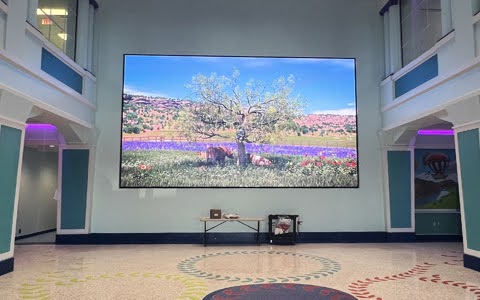
Walk into a modern control room, corporate lobby, broadcast studio, or exhibition hall, and the first thing you notice is not pixel pitch or cabinet size—it is continuity. A truly seamlessindoor LED display feels like a single, uninterrupted visual surface. Images flow naturally, text remains crisp across boundaries, and motion appears stable no matter where you stand. This sense of unity does not happen by accident. It is the result of a deliberate implementation logic that connects design, manufacturing, installation, and calibration into a single coherent process for an indoor LED display
Core Design Principles of a Seamless Indoor LED Display
The foundation of seamless performance begins at the design stage of the indoor LED display. In the first part, mechanical precision is critical. Cabinet flatness, structural rigidity, and consistent tolerances ensure modules align perfectly during assembly. Even minor deviations can create shadows or misalignment that the eye immediately detects on an indoor LED display.
The second part focuses on pixel-level consistency. Uniform LED binning, consistent driving characteristics, and controlled manufacturing processes ensure that brightness and color behave predictably across indoor LED displays. When modules are designed to work together from the start, visual continuity becomes achievable rather than theoretical.
The third part highlights design integration. A seamless LED display is not just a collection of panels; it is a unified product. Power, signal routing, and heat dissipation must be considered together to ensure stable performance across the entire screen during continuous operation.
Structural Accuracy and Installation Discipline
Even the best-designed product can fail without proper installation. In the first part, structural accuracy begins with the supporting framework. Whether wall-mounted or floor-supported, the mounting surface must be flat, stable, and precisely leveled to support a seamless indoor LED display.
The second part emphasizes cabinet alignment. Installers must follow strict alignment procedures, tightening sequences, and spacing controls. Uneven pressure or rushed assembly often leads to micro-gaps that appear as visible seams once the LED display is powered on.
The third part addresses environmental factors. Indoor temperature stability, vibration control, and long-term structural support all affect how well an LED display maintains its seamless appearance over time. Installation discipline is not a one-time effort; it is a commitment to lasting visual quality.
Signal and Image Consistency in an Indoor LED Display
Visual continuity relies heavily on signal handling. In the first part, synchronized signal distribution ensures that every section of the LED display refreshes simultaneously. Even slight timing differences can cause tearing or motion inconsistency across seams.
The second part focuses on image mapping accuracy. Each module must display the correct portion of the image with precise pixel alignment. Accurate mapping allows graphics, lines, and text to cross cabinet boundaries smoothly on the LED display.
The third part highlights stability under load. When displaying complex or fast-moving content, a well-implemented indoor LED display maintains consistent image behavior, free of jitter or delay, reinforcing the perception of a single, continuous screen.
Brightness and Color Uniformity Across the Screen
Uniform brightness and color are essential for seamless viewing. In the first part, factory-level calibration establishes a baseline for consistency. Each module in the LED display is measured and adjusted to match a defined standard before installation.
The second part addresses on-site fine-tuning. Environmental lighting, viewing distance, and content type can affect perception. Fine adjustments help ensure that the LED display appears balanced under real operating conditions.
The third part explains why consistency matters more than maximum brightness. A slightly lower but uniform brightness level looks far more seamless than uneven intensity. Viewers instinctively notice differences, making uniformity a defining feature of a high-quality indoor LED display.
Maintenance Logic for a Seamless Indoor LED Display
Seamless performance must be preserved, not just achieved. In the first part, front or rear maintenance design plays a major role. Easy module access allows technicians to service the indoor LED display without disturbing adjacent panels, reducing the risk of misalignment.
The second part focuses on replacement consistency. Spare modules should match the original specifications closely to avoid visible differences. A seamless LED display depends on continuity not only at installation, but throughout its service life.
The third part highlights routine inspection. Periodic checks for alignment, brightness balance, and signal stability help maintain the original seamless appearance. Preventive care ensures that the indoor LED display continues to perform as intended.
Common Seam Issues and Practical Prevention
Most seam-related issues follow recognizable patterns. In the first part, visible lines often result from uneven cabinet pressure or structural settling. Addressing these early prevents permanent deformation of the LED display.
The second part discusses color shifts at boundaries. These typically occur when calibration data is inconsistent or outdated. Regular updates and careful handling help maintain uniform color across the LED display.
The third part covers content-related artifacts. Improper scaling or mismatched resolution can exaggerate seams. Correct content preparation ensures that the LED display presents images smoothly, regardless of layout or resolution.
Concluding Logic Behind a Seamless Indoor LED Display
In conclusion, a seamless LED display results from clear implementation logic rather than isolated improvements. In the first part, thoughtful design establishes the physical and visual foundation needed for continuity.
The second part reinforces the role of disciplined installation and calibration. Precision at each step ensures that the LED display behaves as a unified visual surface rather than a collection of parts.
The third part looks at long-term performance with confidence. When design, installation, and maintenance align, the indoor LED display delivers consistent, seamless visuals that meet the expectations of demanding indoor environments. This is the true logic behind seamless implementation—and the standard that defines a professional LED display.
